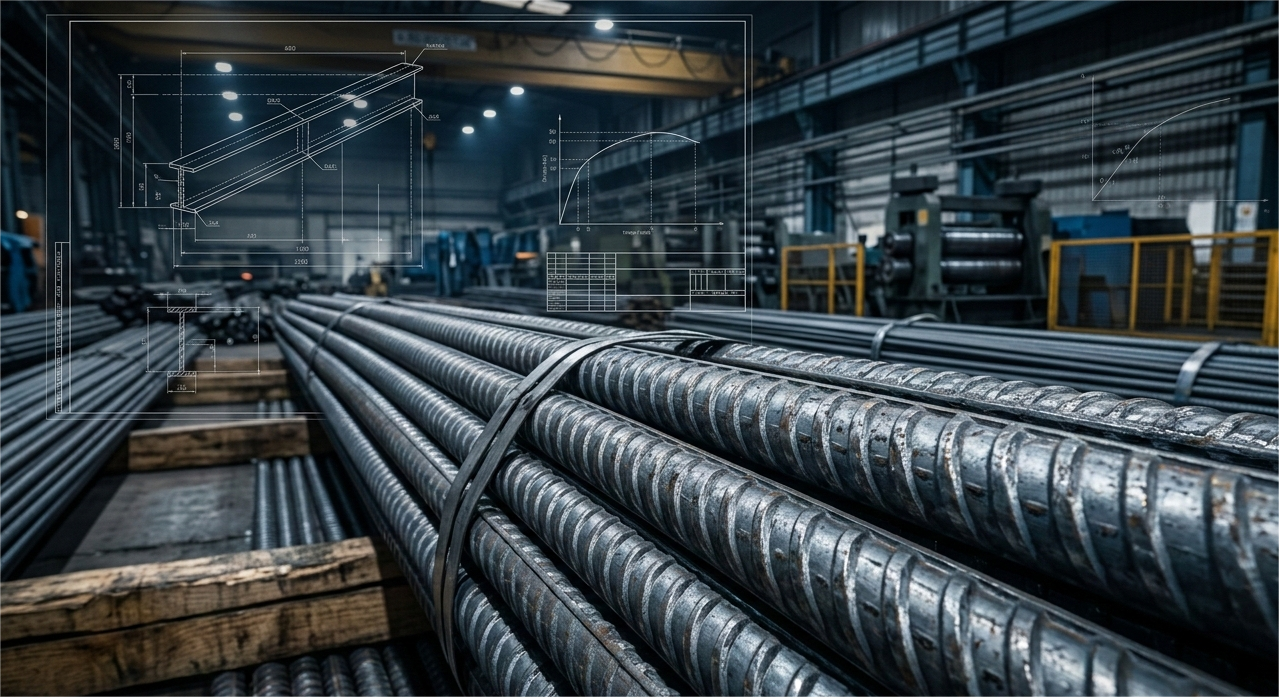
Why Yield Strength Alone Cannot Define TMT Bar Quality

Introduction
When selecting TMT bars for construction, most buyers focus on one number, yield strength. Grades like Fe 500, Fe 550, and Fe 600 are often compared purely based on their strength value in megapascals (MPa).
But here’s the truth:
Yield strength alone does not determine the overall quality of a TMT bar.
In modern construction, especially in high-rise buildings, seismic zones, and urban infrastructure reinforcement steel must deliver far more than just high strength. To ensure long-term structural safety, engineers must evaluate ductility, elongation, bendability, fatigue performance, chemical composition, and manufacturing consistency.
This is where advanced reinforcement solutions like VRKP Nexa TMT (FE 550 & FE 550D) stand apart.
What Is Yield Strength — and Why It Matters
Yield strength refers to the stress level at which steel begins to deform permanently. For example:
- Fe 500 → 500 MPa
- Fe 550 → 550 MPa
- Fe 600 → 600 MPa
Higher yield strength means the steel can resist higher loads before permanent deformation.
But construction is not only about resisting load, it is about how steel behaves under real-life conditions.
The Problem With Judging TMT Bars Only by Strength
Focusing solely on yield strength can create several risks:
1️⃣ Higher Strength Can Mean Lower Ductility
As strength increases, ductility often decreases.
Low ductility steel:
- Absorbs less energy
- Breaks suddenly
- Performs poorly in seismic conditions
For Indian construction especially in seismic zones ductility is critical.
2️⃣ Structural Safety Depends on Controlled Deformation
During earthquakes or heavy wind loads, structures must:
- Bend
- Absorb energy
- Redistribute stress
Steel that is strong but brittle may fail suddenly without warning.
Balanced strength + ductility is far safer than extreme strength alone.
3️⃣ Real-Life Loads Are Dynamic, Not Static
Buildings face:
- Wind vibrations
- Temperature variations
- Traffic-induced vibration
- Cyclic loading
Yield strength does not measure:
- Fatigue resistance
- Crack control performance
- Long-term durability
These depend on steel quality and microstructure.
What Truly Defines High-Quality TMT Bars?
Instead of just yield strength, engineers should evaluate:
✔ Ductility & Elongation
Higher elongation means better energy absorption and safer seismic performance.
✔ Ultimate Tensile Strength (UTS) Ratio
The ratio between tensile strength and yield strength indicates deformation capacity.
✔ Bend & Re-bend Performance
Steel must withstand on-site handling without micro-cracks.
✔ Chemical Composition
Controlled carbon, sulphur, and phosphorus levels improve durability and weldability.
✔ Manufacturing Process
Thermo-Mechanical Treatment (TMT) must produce:
- Strong outer martensitic layer
- Tough inner ferrite-pearlite core
- Uniform microstructure
Consistency matters more than numbers.
Why FE 550D Is Often Better Than FE 600
In many Indian construction scenarios:
- FE 600 offers higher strength
- But may provide lower ductility
On the other hand:
FE 550D offers:
- High strength
- Enhanced ductility
- Better elongation
- Superior seismic performance
This is why many engineers prefer FE 550D over simply choosing the highest grade available.
How VRKP Nexa TMT Balances Strength and Performance
VRKP Nexa TMT (FE 550 & FE 550D) is engineered to deliver:
- Optimized yield strength
- High ductility for seismic resilience
- Strong bond strength with concrete
- Consistent chemical composition
- Reliable fatigue performance
- Uniform microstructure through advanced TMT processing
Rather than chasing the highest MPa number, VRKP Nexa TMT focuses on delivering balanced structural performance.